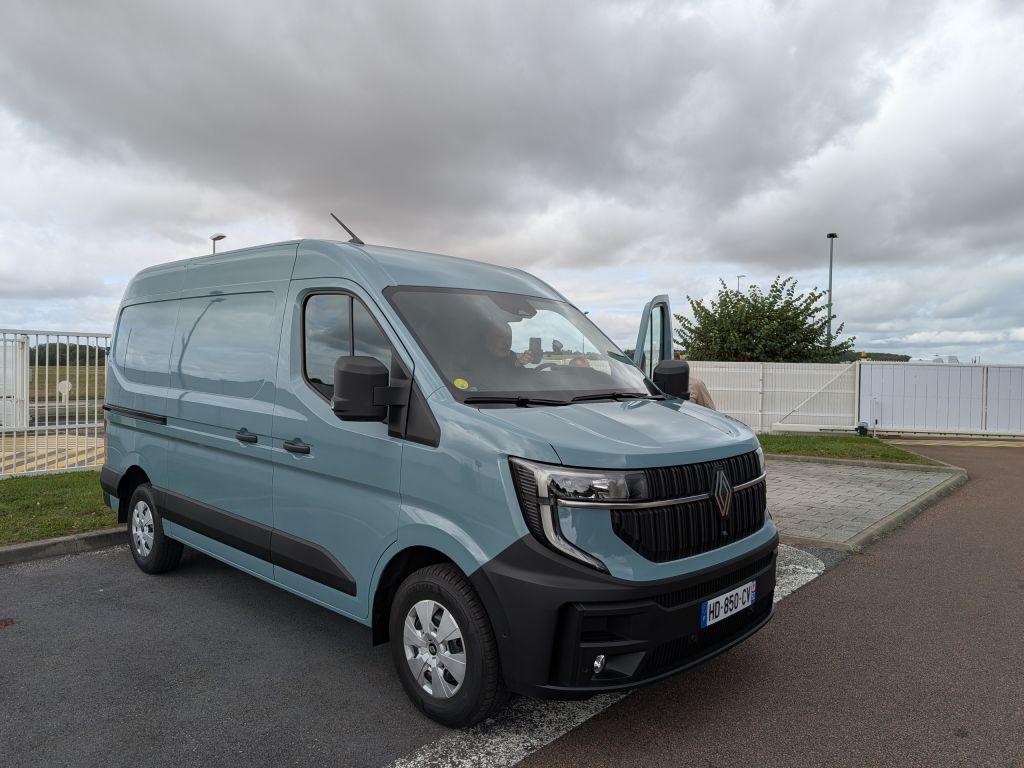
Diesel is dead—long live Diesel: At least in the Renault Master this will remain the case until the end of the generation that was completely relaunched only last year. And the predecessor had been in service for more than ten years. Thus the diesel engine runs almost exactly up to the supposed end of the internal-combustion era in new registrations, unless the EU Commission buckles under the onslaught of combustion-engine enthusiasts demanding an extension.
Be that as it may: Thanks to a ZF eight-speed automatic, Renault engineers squeeze out again everything from the 2.0-liter diesel, painstakingly cleaned to Euro 6ebis via two SCR stages, a DPF and an Oxikat. For in conjunction with the complex drivetrain, the Master no longer feels as sluggish and somewhat reluctant to accelerate as with the manual, but almost as alert as the purely electric counterpart, which it also has thanks to the multi-drive platform. And incidentally it accounts for about 11 to 12 percent of the portfolio, selling fairly well, even as overall brand sales decline, both in general and in the van market, note.
Nur der Stromer kommt flotter aus den Puschen
Sure, the electric variant with its 300 Nm from zero rpm pulls away even quicker, and is quieter to boot. But the automatic moderates the spontaneous acceleration after releasing the brake well, shifting rapidly, jerk-free and very smoothly upward. So the diesel noise is well masked and becomes a low, sonorous rumble in the background that you can live with. And you can leisurely, easily and effortlessly cruise at 80 to 100 km/h on the country road, and completely forget the substantial weight of the 3.5-tonner.
In
the not entirely serious, in the context of the 60th anniversary of the Villiers conversion plant, a direct comparison with the 93-era original Master (built 1980-1997) makes progress tangible in the true sense: laborious, strenuous, loud and stubborn was van propulsion back then when viewed from today, although the Master of that era was very modern and set new standards. It was loud anyway, with the 2.5-liter naturally aspirated diesel mounted in the middle under a box that, ex nunc, offered a lean 76 HP. To reach 100 km/h, one had to work quite hard.
Was für ein Fortschritt: Direkter Vergleich zum Ur-Master
Not to mention the undefined clatter in the five-speed gate, which you could operate with a gear lever planted rather arbitrarily beside the driver, or the bulky umbrella-style handbrake at knee height, or the mushy clutch, the twitchy throttle and the tilted pedal box, the sluggish brakes, the heavy steering, the roughly opening, crashing closing, and narrow sliding door, etc., and so forth... However the original ancestor weighed 1.8 tonnes — exactly 500 kg less on its steel frame — and as a 3.5-tonner had more payload than the hefty grandson with its (at least) 2.2 to 2.3 tonnes empty. Also the loading volume itself and the low loading edge could be seen — and used.
Gut sortiert: Immer den richtigen Gang parat
Back to today and here: Almost always the ZF-shift box in the comfortable 2025 Master keeps the right gear ready; with kick-down it can get a bit louder and rough. The shift paddles for manual input are not really needed, unless you deliberately want to enjoy the hefty torque of
the Twin-Turbo engine (380 Nm on the Dci 170, 360 on the Dci 150) and insist on keeping the gear on hills. The 2,500 kg trailer load should not be a problem there.
Rangieren is easy thanks to a well-dosed creep moment via the brake pedal. Renault should, in addition to the "keyless start," urgently add a space-saving and modern electric parking brake instead of the bulky lever beside the driver's seat. Due in 2026, they say. Perhaps then there will also be a "keyless Go" system, which for a delivery van in a continuing boom of deliveries is basically a must-have feature.
Motorbremse: Kein Vergleich zur Rekuperation
Apropos Berg: Downhill the transmission will hold the gear if engine braking is needed. Of course, this is not a match for the recuperation of the pure electric, which in such situations diligently feeds energy back into the battery, while with the diesel the energy simply dissipates as heat and warms the atmosphere. Sooner or later, the diesel is already an out-of-date model for this reason. Brake use downhill is not avoidable; good that the Master stoppers are alert and bite hard.
7.9 l/100 km are recorded after trips over 100 kilometers, a good figure in the "old combustion world" and even more so for an automatic that should not consume more than the manual, perhaps aside from pure city operation. Thus, it roughly aligns with WLTP values. But in absolute terms that is a high CO2 figure compared with BEV: in energy equivalent that would be 80 kW/100 km, if you exclude the energy costs for refining the diesel, honestly more like 90 to 100 kWh/. The
electric vehicle proved not exactly ascetic in our test either, but stayed at 34 kWh/100 km, two thirds below the diesel. If you also use green electricity, the balance clearly favors BEV.
Recht fair gepreist: 1.800 Euro Extra
For that, the diesel with automatic scores with a cheaper purchase price: about 1,800 euros extra Renault asks for the fine Friedrichshafen gearwork in the completely adequate 150 dCi version (from 39,190 net), a fair deal for so much comfort and agility. The 170 dCi EAT9 (+1,400 euros) can be skipped; the 200 Nm more torque and the higher output are hardly noticeable. Also important: with all Renaults, manual, automatic or electric, a 40,000-kilometer maintenance interval is now standard.
The same box — here in the somewhat space-hungry, old-fashioned shift console instead of, as with the Master, in its own steering column — also transforms the Trafic into a little "sportscar" in its "old days" and refines the whole package to a rather taut, rugged model, still a commercial vehicle but very capable and angular.
Pure electric will run in parallel to the combustion Trafic from next year with the "Flexis-Trafic" featuring a powerful synchronous front-drive. Then one should also be curious how long the diesel will hold out. But if you do, with automatic, a clear recommendation—at least for long-distance driving and not in urban or suburban environments. Then you should already consider the pure electric today: The city radius of about 400 kilometers is more than enough, and thanks to 130-kW DC and 22-kW AC chargers it can be quickly extended again. And you can then calmly follow the diesel debate and extended entry restrictions from