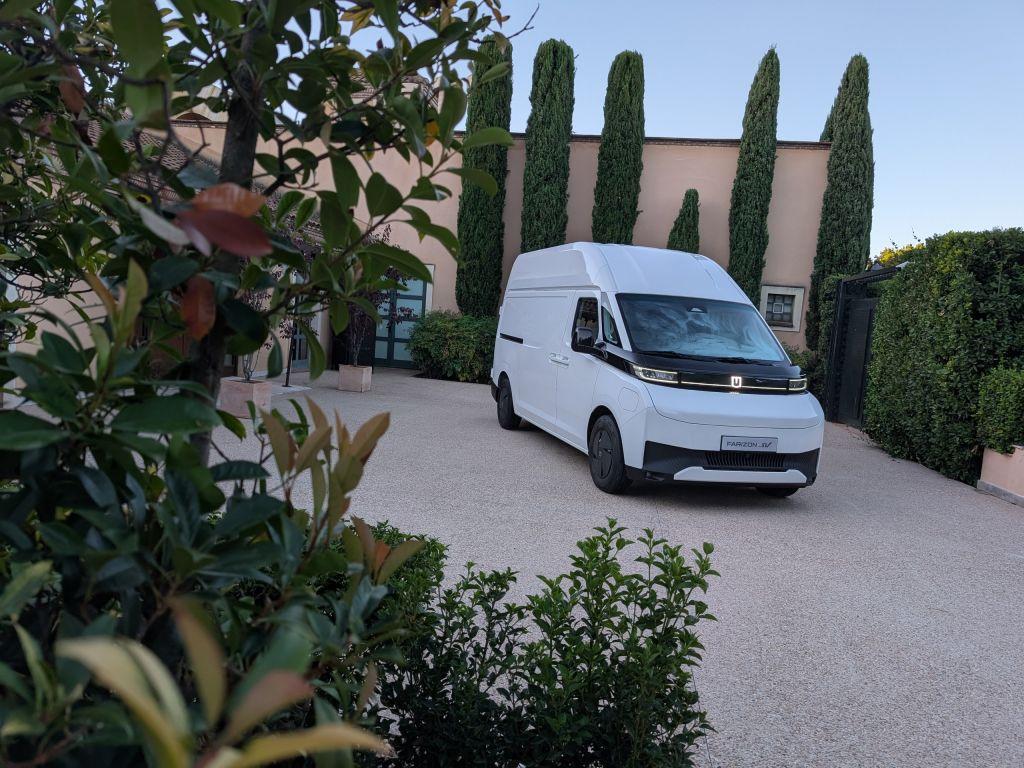
Even in the Middle Kingdom, „China-Speed“ is relative: While the Geely-empire’s passenger-car brands—Polestar, Volvo, Lynk & Co, Lotus and Zeekr—take 18 months of development time for a new model as a maxim, with the Farizon van it was indeed a good three years. That is still a hell of a pace in relation to European brands—and underscores the big ambitions of the brand, founded only in 2016, which in the coming years plans to bring to market not only E-vans but also New Energy Trucks and buses. Within the group, synergies are diligently exploited, for example in safety, body-in-white stiffness and handling with Volvo and its R&D department in Gothenburg.
The metal-bodied result of the rapid development work does by no means look sloppy or cheap. As Geely generally does not see itself among Chinese brands as “cheap,” but as a premium provider. This claim should also apply to the vans, where they have not designed an over-candid interior, but have used decent plastics that are neatly joined and overall give a robust and appropriate impression.
The same goes for the “metal skin”: Wherever you touch it, it has form and function, literally in the case of the prank-ready door handles. The doors themselves open smoothly, the sliding door latches in securely, the cabin portals open extremely wide and here the first big highlight becomes apparent. For the SV, there is no B-pillar, in favor of another opening. That only makes sense if one adds a flexible partition and a fold-down seat, which, as the engineers assure, will follow.
Mängel nur im Detail
By the way, they also plan to refine standards such as seat height adjustment and steering-wheel reach adjustment. And a rear-view mirror, digital or analog, they had simply forgotten so far. The side mirrors fit as well as the generally good forward visibility (if only you could raise the seat higher!) or the instrument panel, which has two fairly clear screens, while the central cluster could deliver clearer and more driving information or the status of recuperation. In general: the button for adjusting the three-stage recuperation modes is found rather accidentally; it sits hidden on the left in
the control strip. Not optimal in bright light is also the semi-transparent strip for the ventilation control, but at least there are two sturdy sliders for ventilation and temperature.
Complete driver assistance on board
The somewhat hard and featureless seats could generally be more comfortably cushioned, and there is no A4-sized compartment for freight documents. Otherwise you get along fine, the stowage situation is decent, USB ports are present, the through-load is fairly easy thanks to a perfectly flat floor. You sit far forward in the vehicle, which demanded a lot from the engineers to achieve the five stars in Euro NCAP crash tests. Thanks to the 30 driving assistants that come as standard on board, this was achieved. The SV is therefore also a safe vehicle, although the systems’ reliability still leaves room for improvement: they beep and report rather nervously, for example when you roll just two km/h over the limit.
Cab-Forward: Everything in front saves space
The big advantage of the Cab-Forward design, which transfers the Fiat Ducato concept into the electric era: behind the solid bulkhead there is a tremendous amount of storage space. In the three lengths of just under 5 meters, 5.50 meters, and 6 meters, there is 7 to 13 cubic meters of volume available, in three heights Flat/Medium/High, at a modest 1.98 meters in width. The loading length is 2.74 meters, the loading width 1.79 meters and between the wheel wells there remains 1.37 meters, which already in the base configuration is easily enough for two pallets. Particularly interesting for delivery services should be the smallest version, which at 1.98 meters in height remains deep-garage compatible.
But the high-roof long version with its 13 cubic meters also keeps its measure. Also nice is the square-practical rear opening and the 52-centimeter-low loading edge, as well as the eight sturdy tie-downs or the power connections for external consumers in the rear cargo area. Under the hood, whose plastic apron is completely removable, there is only the refill cap for the windshield washer fluid. The vehicle is space-efficient, at least.
High payload for an E-Van
Thanks to the dedicated development as an E-Van, including weight- and
space-saving highlights such as drive-by-wire technology, the engineers were able to consistently exploit the peculiarities, integrating, for example, the 15-centimeter ultra-thin batteries into the structure (Cell-to-Pack) from high-strength steels and thereby realized not only a lot of space but also what E-Vans have so far completely lacked: high payload.
The L1H1 variant, with its two-ton curb weight and an overall gross weight of 3.5 tons, can carry almost 1.5 tons of payload; the largest SV is still 1.1 tons. From that, eSprinter, E-Transit or ID.Buzz can only dream. They have also considered adequate axle loads, with 1,800 kg at the front and 2,350 kg at the rear. A towing capacity of 2,000 kg can also be accommodated on the hitch, though one should add the option of a tachograph. Another advantage of the “Everything-forward” approach: under the rear there is a real spare wheel, a feature one has almost forgotten amid tire-fit asceticism.
Swift propulsion
All told, as with vans, space on the plate is what matters. And the Farizon-Van does not disappoint here either. Nimble, but not hasty for its class, the 500 kg loaded electric van with its synchronous motor (170 or 200 kW, 343 Nm) pulls onto the front wheels; already in Eco mode it moves forward at a completely adequate pace, Normal and Sport then alter the response. At 135 km/h the acceleration ends, which is reasonable, even though the SV for a transporter has a very good Cd value of 0.29.
Wind noises do not get too loud, not even through the thoroughly insulated, B-pillar-free side opening. The rolling noise is also well damped and the SV rides nicely, keeping the roughest conditions away from the driver. No creaking can the fortress-like bodywork be coaxed into producing; the whole construction feels compact. The easily operable drive-by-wire steering does simplify maneuvering, but also masks that the SV sits quite well and securely on the road and, in the spirit of its Volvo or Polestar brothers, also has dynamic potential. Fine, rather casual, for a van.
Range fits, large battery options
Here range is the bigger story and in this metric the Geely van also holds up: on
two trips with the L3H2 van and the L1H1 model we achieved 20.5 and 22.6 kWh/100 km. Officially it should be around 24 kWh/100 km. We drove the compact vehicle a bit more “sportily,” it feels also more agile on the road. So this could line up with the stated ranges of 215 to 398 kilometers WLTP or 284 to 551 kilometers WLTP City. Farizon, however, offers a broad selection of batteries to fit the use case. The entry batteries are the cheaper VREMT units at 49 and 66 kWh; the upgrade then the CATL storage with 68, 83 (LFP) or even long-range 106 kWh (NMC) capacity. We’ll be watching the pricing. But range anxiety can no longer be used as an excuse.
Contemporary charging technology
To that end, one pairs contemporary charging technology with 6.6 kW AC as well as 130/150 kW for the VREMT batteries and 11 kW AC as well as 105 and 127 kW DC for the CATL storage. In 30 minutes it should go from 20 to 80 percent, within a 400-volt system, to which Geely in this class uses it like Kia with the PV5, but unlike Renault’s Flexis competition. The charge port sits quite conveniently and somewhat shock-resistant on the right above the fender. V2L the SV can of course do as well, feeding external consumers with 3.3 kW.
Prices should start under 40,000 euros
Farizon has not yet given final statements on prices, but has already hinted that, in keeping with the company philosophy, they do not want to be cheap, but affordable. Moreover – also here in Geely style – the vans will arrive with full equipment: as an extra only the 270-degree rear-door opening is listed. Otherwise, in the truest sense of the word, “everything is included,” from the aforementioned driver assistance, to air conditioning, keyless start, wireless CarPlay, air conditioning, heated seats, plastic flooring, LED front and rear lights, rear parking sensors, door-opening warning, 12.3-inch infotainment, and so on. Under 40,000 euros it should start. To get commercial customers on board, they are currently building a dealer and service network. Because even a van made of high-strength steel may break