After the city of Munich decided to expand bicycle logistics in March, the new XXL bicycle logistics hub has now been opened on the grounds of the former parcel post hall in the presence of the city leaders and logistics officials. Covering an area of over 2,000 square meters, Germany's largest provider-independent bicycle logistics hub has been created in the basement of the site, bringing together various logistics and cargo bike service companies under one roof. The area is rented by the mobility department and subleased to (bicycle) logistics companies. This is part of the interim use project "Pineapple Park". The costs for the new bicycle logistics area can be covered during the project's duration from 2025 to 2027 by rental income and project funds from the EU project metaCCAZE.
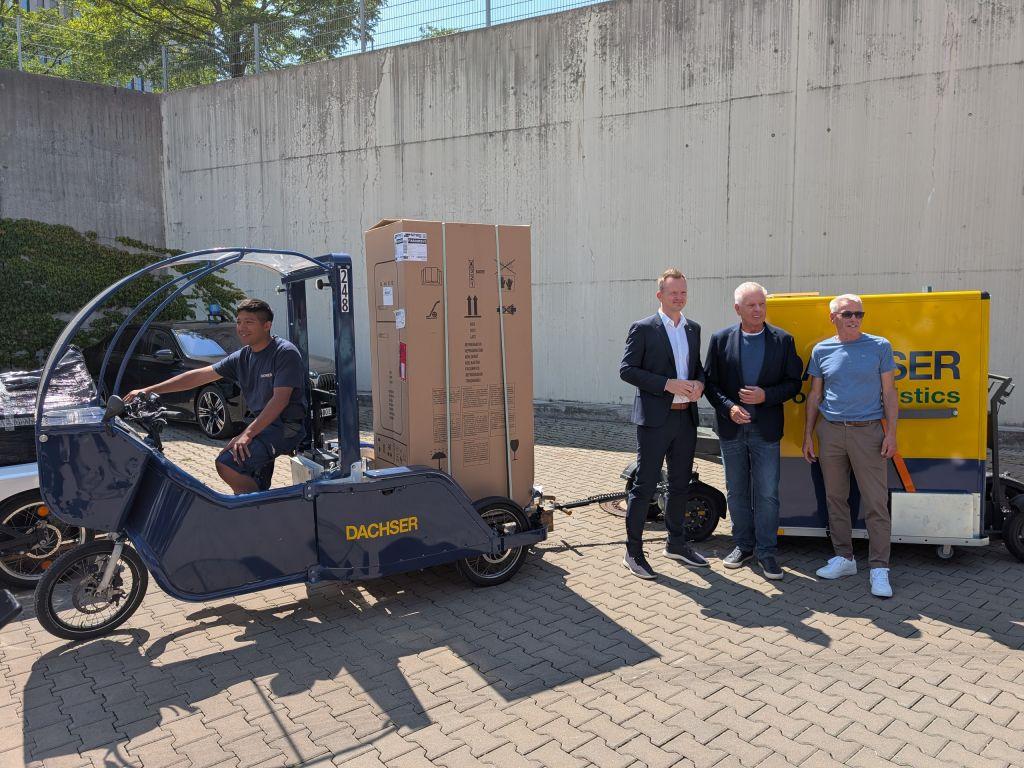
Mayor Dieter Reiter (SPD), Mobility Officer Georg Dunkel, and the Officer for Labor and Economy Christian Scharpf took a look behind the scenes of the new hub during a press tour. Also present is Stefan Behrendt, Managing Director Food Logistics at Dachser, who introduces the pilot project for refrigeration logistics with cargo bikes at Dachser Food Logistics. For the first time, refrigerated goods are being transported by cargo bike at the Allgäu-based logistics company.
Premiere for Refrigeration Logistics with Cargo Bikes
An active cooling system from the Denso spin-off GreenZen Solutions is used, guaranteeing a closed cooling chain and currently ensuring a 20-kilometer radius with one tour. Nearly 200 refrigerated deliveries have already been made, with further optimizations underway. A swap body currently serves as a "cold storage"; in the future, a hall in the hub is planned for this purpose. The impulses for these solutions
also come from customers, as well as from the European Union — and from the traffic-congested reality in Munich, reported Behrendt. In addition, companies such as B4B Logistics, GLS, and Pacflix are active at the new location. Further discussions, for example with UPS and Amazon, are promising, according to those responsible.
Last Mile by Bike is Great, Says the Mayor
The Munich mayor, who admitted he is not necessarily a fan of cycling himself, is convinced that commercially used cargo bikes could play an important part in relieving the heavy traffic in the state capital. Completing the last mile by bike saves many trucks and reduces dangerous situations caused by double parking, said Reiter. He believes the application is not only useful for parcel services but also for many trades and crafts. Commercially used cargo bikes are no longer niche applications, as stated by Mobility Officer Georg Dunkel regarding the rising revenues of bike logisticians, which were 190 million euros in 2024. This has saved 2,200 tons of CO2 and 8.5 million kilometers have been covered by cargo bike.
Shifting to Bikes Can Relieve Delivery Zones
Economics Officer Scharpf sees cargo bike logistics as a factor that enhances the attractiveness of the business location. With high immigration to Munich, space doesn't grow accordingly, hence innovative approaches and solutions are needed. While most goods will likely still need to be transported by truck, cargo bikes are an important complement and relief, especially in the dense old town. Additionally, the shift of parts of commercial traffic to bikes can relieve delivery and loading zones. Project manager Christiane Behrisch emphasized that the endeavor is especially desired by companies and
will support itself with full occupancy. Nevertheless, funding is important and essential as an initial push, especially for startups.
Over Ten Times the Area
The new hub is the tenfold scaled version of the first bicycle logistics hub, which opened in August 2023 as part of the municipal part-strategy “Commercial Traffic” at the Viehhof. The location quickly established itself and proved its worth: According to their own statements, companies have been able to save up to 30 percent time on the so-called “last mile” of delivery in recent months, as searching for parking and traffic delays are eliminated. In total, in the first nine months of bicycle logistics operations at the Viehhof, 8,000 hours of standing time in public spaces were reduced and 260,000 shipments were delivered, as recorded in March 2025. At the same time, bicycle logistics relieves the delivery zones in the city center. According to all experiences, ten transporters can be replaced with 15 cargo bikes, summarized Dunkel.
Ideal Location in Former Postal Area
In view of these successes, more and more logistics companies have shown interest in expanding deliveries by cargo bike within the Mittlerer Ring, for which new, larger transshipment points are needed. On the new, spacious, underground area previously used by the Post for mail logistics, traffic routes, ramps, and social spaces already exist and can be used communally. Additionally, service companies, such as maintenance and workshop partners, are also expected to rent space. Showroom areas for cargo bike manufacturers are to be integrated to practically demonstrate and test the advantages of cargo bike use to businesspeople.
"Munich is the capital of online shopping, no other city receives as many
parcels and packages as we do, according to statistics. This results in a lot of delivery traffic, and we need innovative solutions for this. More and more logisticians rely on inner-city delivery by cargo bike. The big advantage of cargo bikes is that they don’t get stuck in traffic jams and finding parking is easier. This saves companies time and money. The Munich bicycle logistics hub is a real success story. I am pleased that we are now continuing it with the XXL hub," said Mayor Dominik Krause after the decision in March.
Peter Blösl from B4B Logistics was also the idea provider for the showroom, who considers it essential to also win over artisans for cargo bike use. It's about breaking down prejudices and perhaps initially adding a cargo bike to the rest of the fleet, said Blösl during the tour. Trade shows or small house fairs are also planned to specifically target industries. Gaps that have existed so far are to be closed.
Bicycle Logistics is Already Attractive Today
From the perspective of Mobility Officer Georg Dunkel, bicycle logistics in Munich is already so attractive for companies that one and a half years after the opening of the first bicycle logistics hub at the Viehhof, a second, ten times larger bicycle logistics hub is being tackled. He expressly appreciated the support of the Chamber of Industry and Commerce in finding a suitable space.
"That we can implement this for the city budget cost-neutrally, thanks in particular to the support of the EU project metaCCAZE, is a great relief — and an important contribution to promoting sustainable commercial traffic in Munich," explained Dunkel in March.