Stagecoaches and mail bicycles were and are the classics of emission-free delivery. But over the decades, Deutsche Post repeatedly sought new ways for environmentally friendly delivery. Early on, it experimented with electrically powered vehicles that travelled quietly and emission-free. But for a long time, the deployment possibilities were limited, ranges short, and the technology underdeveloped. Electric vehicles remained only niches in the delivery operation.
With tens of thousands of electric delivery vehicles, emission-free delivery at Deutsche Post DHL has become part of everyday life. The company's e-fleet for pickup and delivery of shipments consists of more than 42,000 electric vehicles.
But it took a while to get there:
1910s: First electric tricycles
Around 1910 the Reichspost began using electrically operated tricycles from the Berliner Elektromobil-Fabrik. The “B.E.F.-Wagen” reached a top speed of 18 kilometers per hour and could cover around 50 kilometers – enough for the short runs with “mail bags” or for the then-new “express parcel delivery.” In the 1920s, about 200 of these tricycles were already in use.
The Berliner Electromobil- und Akkumulatorenfabrik Fiedler & Co. KG (BEF) produced electric-powered trucks from 1900 to 1922 at the site Puttkamerstraße 19 in Berlin. The company initially built light and heavy delivery vehicles, including an early electric truck in carriage form with large, iron-wheeled wooden wheels, box body and two 2.5-PS motors on the rear axle. The driver sat unprotected
on a coachman's bench. Later municipal vehicles such as electrically powered street-cleaning machines were added, before Elitewagen AG took over the factory.
1920s: “Heavy-duty” for the big city
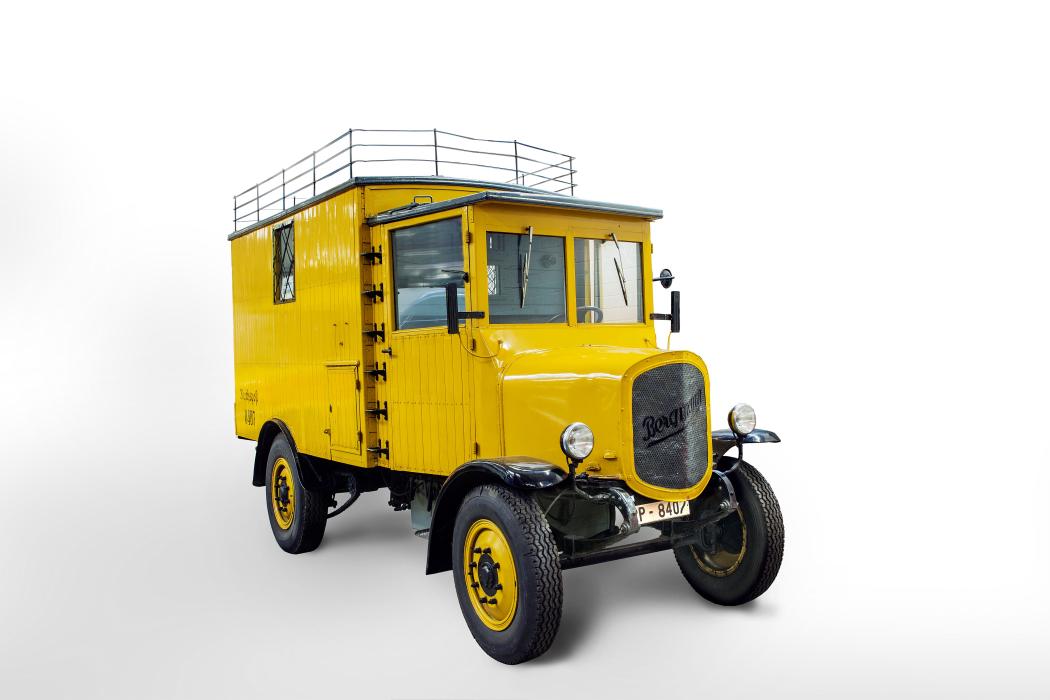
Soon after followed the next advance: the Bergmann BEL 2500. This electric vehicle delivered 25 HP and could reach 20 kilometers per hour. One battery charge was enough for 60 kilometers. The name stood for the payload of 2500 kilograms. Particularly in large cities where routes were short, the BEL 2500 showed that electric vehicles were already suitable for heavy loads.
In a car factory established in 1909 by Sigmund Bergmann, passenger cars were initially produced under licenses from the Belgian company Métallurgique. From 1911 the production of utility vehicles began, including electric trucks with hub motors as well as models with a central underfloor motor and a cardan drive. In 1912, trucks with two tons payload and 24 PS as well as four tons payload and 32 PS were produced. During World War I, the plant built army trucks with 3.5 and 4.5 tons, delivering 38 and 40 HP respectively. A technical specialty of that era were two-block engines with cylinders offset on the crankshaft. Additionally, 1.5-tonners and other special types were produced. After the war, commercial vehicle production was reduced and switched to gasoline engines, while the production of electric vehicles continued.
1950s: Clean air in postwar Germany
Even after
World War II, they remained part of the fleet. In the 1950s, the Post used the EL2500 E from Maschinenfabrik Esslingen. With a daily range of 18 kilometers and a top speed of 28 kilometers per hour, it proved especially useful in the Freiburg area. In a time when environmental issues were gaining weight slowly, the EL2500 E stood for the hope of clean air in the cities.
From 1926 to 1963 Maschinenfabrik Esslingen built electrically driven commercial vehicles. Buyers included the Deutsche Reichsbahn and later the Deutsche Bundesbahn, where the electric cart EK 1002 with one ton payload and motors of 2.0 or 2.75 kilowatts were widespread. In addition, the EK 2002 with two tons payload was manufactured. The Deutsche Bundespost used the EL 2500 as a parcel post wagon, developed according to the Post's plans and also built by Lloyd in Bremen as well as Gaubschat in Berlin. It was equipped with a 10.3-kilowatt motor; the cabin was heated with a coal stove. Other models were the EL 3001 as well as the four- and five-ton EL 4001 and EL 5001 with a Daimler-Benz 3.5-tonner driver's cab. Some preserved vehicles are today on display at the Museum of Communications in Frankfurt, at the European Bread Museum in Ebergötzen, and at the German Museum of Technology in Berlin.
2010s: The StreetScooter as a pioneer
In the 2010s, Deutsche Post
took its next big leap. Together with RWTH Aachen University, the StreetScooter Work was created – a tailor-made electric vehicle for delivery. In 2012 the first prototype rolled off the line; by 2014 the vehicles were in widespread use. With 65 HP, up to 85 kilometers per hour and a robust build, the StreetScooter brought pace and endurance to the road. Variants such as the Work L and XL, as well as right-hand-drive versions for safer entry on the sidewalk side, followed. The in-house development made Deutsche Post a pioneer of modern e-mobility, before production was later discontinued.
Today: High-tech fleet on the last mile
Today DHL Group relies on partners such as Ford and Mercedes. The Ford E-Transit is an example of the current state of the art: Up to 317 kilometers of range, 184 to 269 horsepower and a quiet, emission-free operation make it the ideal vehicle for the last mile. In many cities, e-delivery vans now shape the everyday urban landscape.
Future: Electric long-distance transport
For longer distances, the outlook goes further ahead. Together with Scania the DHL Group developed a The electric truck with range extender. This “Extended Range Electric Vehicle” runs primarily on electricity, but can use a diesel engine as a generator to charge the battery when needed. With up to 400 HP, it combines range and performance – a solution for electric long-distance