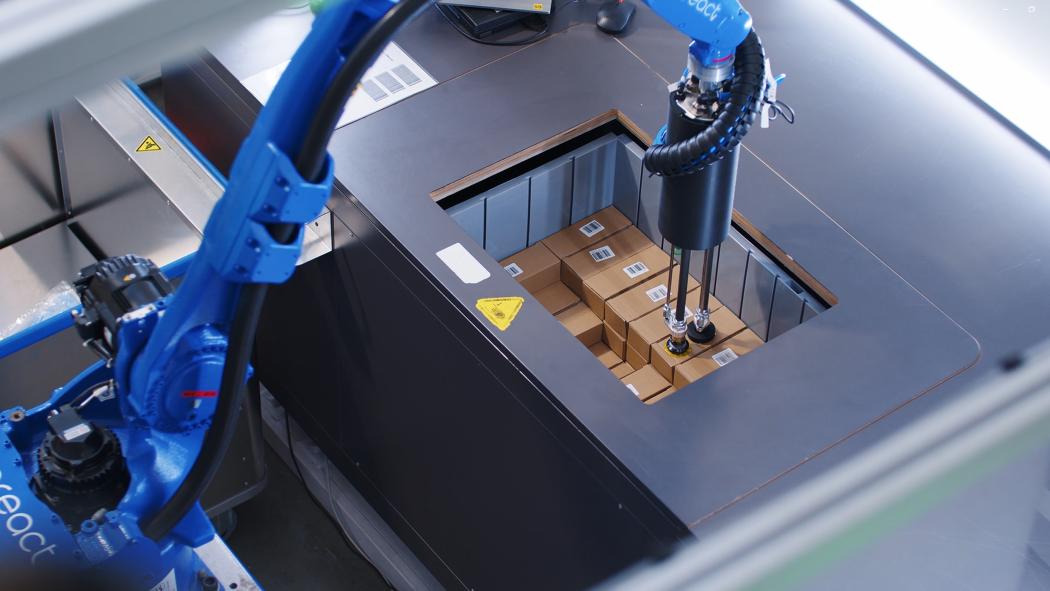
The Stuttgart-based company Sereact develops AI-assisted robotics systems that can handle physical tasks such as grasping, placing or sorting objects in real time and without manual programming. The foundation is the company's Embodied-AI technology. This not only gives robots visual and motor capabilities, but also the ability to make context-aware decisions.
A core component of this technology is the so-called Vision-Language-Action model (VLAM), which links visual, linguistic, and physical information. In this way, the systems analyze their environment, recognize objects, and independently develop strategies for handling them – also for products that are unknown to them so far. The software's zero-shot reasoning capability makes it possible to avoid lengthy training processes.
AI Recognizes Items
Another product from Sereact is the AI-based analytics platform "Sereact Lens". It serves for real-time monitoring of warehouse processes and automatically detects faulty or mispositioned items. Through this combination of robotics and visual process control, Sereact creates solutions for a new form of warehouse automation that is flexible, scalable and quickly deployable.
The systems can be seamlessly integrated into existing warehouse management and control systems. No additional hardware is required. The software operates purely data-based, which simplifies implementation and reduces investment risks.
The company was founded by Ralf Gulde (CEO) and Marc Tuscher (CTO) and is already in use with customers in Europe and the USA. Sereact's solutions are aimed at warehousing and logistics companies with complex requirements as well as at system suppliers who want to expand their existing infrastructures with AI-based functionality. The use cases range from single-item picking to quality assurance to automated inventory.
Integrators and Partners
A major strategic milestone is marked by the partnership with the Dutch automation specialist AWL. The aim of the cooperation is the integration of Sereact's AI models into AWL's existing robotics systems.
The companies combine traditional robotics with learnable software to develop self-learning systems for intralogistics.
Initial pilot applications to optimize item-picking processes have already started, a worldwide rollout is in preparation. AWL brings over 30 years of experience in robot integration. Sereact contributes the AI solution that enables robots to act safely even with changing product shapes and materials.
Automating AutoStore
A similar objective guides the collaboration with Hörmann Intralogistics. The focus here is the automation of AutoStore systems. Sereact's pick robots operate with zero-shot learning and can recognize and pick items without being programmed beforehand. This enables processes such as goods receipt, picking, and returns to be made more efficient.
Hörmann integrates the systems into its own warehouse management system “HiLIS” and expects higher process speed, reduced error rates and more efficient use of resources as a result. In addition, Sereact Lens is also used to monitor inventories in real time and to detect error sources at an early stage.
Flexible Pick Processes
With Kardex, Sereact has gained another established systems provider as a partner. Here the focus is on flexible pick processes where classical automation reaches its limits. An example is the deployment at Sonepar: a single pick robot picks two parallel orders with changing articles into differently sized target cartons. The system operates, according to Sereact, stably and with minimal human interaction. Kardex plans to use the Sereact technology also for further processes such as goods receipt and quality inspection as well as inventory recording.
Also the technology group Körber cooperates with the Stuttgart company. The aim is the integration of AI-powered pick-and-place technology into automated production and distribution systems. Initial applications are already running with a mechanical engineering customer. The Sereact solution analyzes visual data in real time and dynamically adjusts gripping strategies.
Complex, unknown objects can also be handled safely in this way. The technology integrates seamlessly into Körber's existing ecosystem and creates new opportunities for efficiency gains along the entire supply chain.
First Applications
In addition to these strategic partnerships, Sereact is also used directly in operational warehouse processes. One example is the e-commerce company Active Ants, which has automated its pick-and-place processes with the help of Sereact. At the ports of the AutoStore system, the AI autonomously grasps items, recognizes them visually, and places them space-saving into shipping cartons. The carton height is automatically adjusted to the fill quantity.
According to Sereact, automation increased output by up to 25 percent, and the error rate fell significantly. The implementation reportedly took only two hours. Operating costs were lower than those of two full-time employees. The application was also implemented via a Robot-as-a-Service model. In the future, up to 60 percent of the ports are to be automated. Additionally, the use of Sereact Lens for warehouse monitoring and quality assurance is planned.
Another practical example comes from DeltiLog, a provider of contract logistics. There, seven autonomous pick robots from Sereact are used in an AutoStore system with 160,000 containers. They pick and sort goods without human intervention. The setup is based on a combination of AI software, coordinated hardware and automated replenishment of put walls. The systems are scalable: additional robots can increase throughput without requiring additional personnel.
Also the Swiss company MS Direct relies on Sereact's technology. In its warehouse in Arbon, it automated an AutoStore port with a pick robot that processes around 1,500 single-pick orders daily. The robot, named "Pico" in the company, also works at night, alleviating staff during off-peak hours. The return on investment was achieved, according to Sereact, within nine months. Further
ports as well as the integration of Sereact Lens are planned.
Another approach is pursued by Ludwig Meister, a distributor of drive technology. The company uses Sereact technology for gentle handling of around 2.5 million items, including sensitive rolling and precision bearings. The triple gripper with differently sized suction cups enables safe removal from deep containers. The software recognizes via voice control whether oversized or open packaging is permissible. The success rate lies between 96 and 98 percent. Already three months after the initial contact at LogiMAT, the system was ready for operation. Further applications in picking and quality control are planned.
Overcoming Bottlenecks
The technology is also of interest to smaller companies. For example, the Swiss family business OPO Oeschger has integrated a Sereact pick robot into its automated small-parts warehouse to eliminate a bottleneck in picking. The implementation was carried out without structural interventions; only the interface in the warehouse management system was adjusted. The robot currently operates at reduced speed to avoid overloading the infrastructure and serves as a test field for future scaling.
Finally, Reesink Logistic Solutions, based in the Netherlands, is pursuing a long-term partnership with Sereact. The aim is to develop modular, AI-powered logistics systems that are used in both goods receiving and picking. The systems recognize products visually, evaluate their context, and autonomously decide how to handle them. Sereact Lens is additionally used for inventory control, item classification and returns management.
The multitude of partnerships and realized applications shows how comprehensively Sereact technology is already anchored in intralogistics today. Whether in large AutoStore systems, in production, or in highly specialized warehouses – Sereact's solutions apparently offer high flexibility, quick commissioning, and immediate economic benefits. The company thus positions itself as one of the drivers of intelligent warehouse automation. (Source: