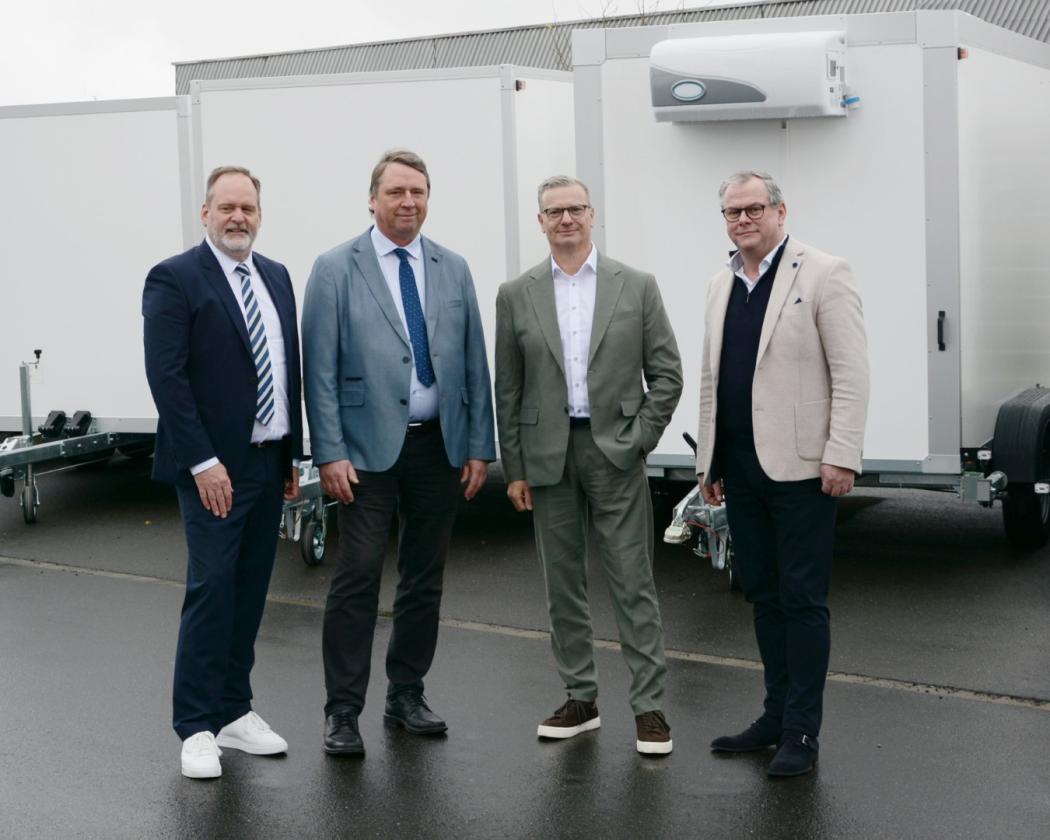
A comparative study conducted by the Fraunhofer Institute for Machine Tools and Forming Technology (IWU) arrives at a remarkable result: In most of the scenarios examined, passenger cars with trailers cause lower CO₂ emissions than 3.5-ton transporters. The client of the study was the Trailer Industry Association (TIV), which represents the interests of European trailer manufacturers and suppliers.
The researchers from Fraunhofer IWU compared various transport solutions across the entire life cycle. A VW Passat with two different trailer types—a low-loader and a box trailer—was paired with a Mercedes-Benz Sprinter 3.5 t. The data basis consisted of life-cycle information from Green NCAP as well as primary data from the trailer production of STEMA Metalleichtbau GmbH.
Manufacturing: Lower emissions for trailers
For the manufacturing phase of the two trailer types, the scientists calculated a Product Carbon Footprint (PCF) according to ISO 14067:2018 and the GHG Protocol. The analysis covered the period from raw material extraction to the factory gate and was based on current production data from the years
2023 and 2024. The results show clear differences between the trailer models: The PCF results amount to about 880 kilograms of CO₂ equivalents for the low-loader and around 2,337 kilograms for the larger box trailer. Due to uncertainties in the background data, particularly with regard to the sandwich material used, a safety surcharge of 20 percent was included. Compared with a transporter, the CO₂ balance in the manufacturing phase is considerably more favorable for both trailers.
Usage phase: Factors and scenarios
In the usage phase, the researchers used a custom-developed calculation tool that links real driving profiles with the Green NCAP data. In addition to annual kilometers, payload and trailer frequency, the aerodynamic drag also fed into the assessment. For simplification, an average speed of 80 kilometers per hour was assumed.
The result: In most scenarios the combination of car and trailer over the entire life cycle is more climate-friendly than the transporter. The driven kilometers, the aerodynamic drag and the usage frequency of the trailer have the
strongest impact on the CO₂ balance. The transported payload, by contrast, plays a comparatively small role. If the trailer is used frequently or has a high aerodynamic drag, the transporter can have the advantage in the overall balance. In urban traffic, where aerodynamic effects matter less, the car-trailer combination performs noticeably better.
Further ecological and practical advantages
According to the study, using trailers goes beyond the pure emissions balance and comes with additional benefits. Driving with a trailer, due to the reduced top speed of 80 to 100 kilometers per hour, leads to fuel consumption that is 20 to 40 percent lower. Maintenance and recycling also fare better: Trailers require fewer wear parts such as tires or lubricants and have a higher recycling rate than complete vehicles.
Furthermore, the study authors emphasize the flexible use of the transport solution. Different trailer types enable a needs-based use, while the towing vehicle can be used for other purposes regardless. Unneeded trailers can also temporarily serve as storage space—a practical side
effect that is particularly relevant for smaller businesses.
Limitations and research needs
The Fraunhofer IWU notes that the results are associated with certain uncertainties. Especially in the usage phase, some values are based on simplified assumptions. Therefore, the researchers recommend in-depth investigations into speed effects, route profiles and specific operating conditions.
What does this mean?
For fleet managers who want to reduce the CO₂ emissions of their fleet, the study provides interesting impulses. A car with a trailer can – depending on the use case – indeed be the more environmentally friendly solution. Especially where transporters are only sporadically used for lighter loads, much speaks in favor of the flexible combination of car and trailer.
However, the ecological advantage only remains if use is organized efficiently and empty trips are avoided. The results show that sustainable mobility is not defined solely by the vehicle type, but by actual everyday use. Or in other words: Sometimes less is simply more – also in transport. (av, source: TIV - Trailer